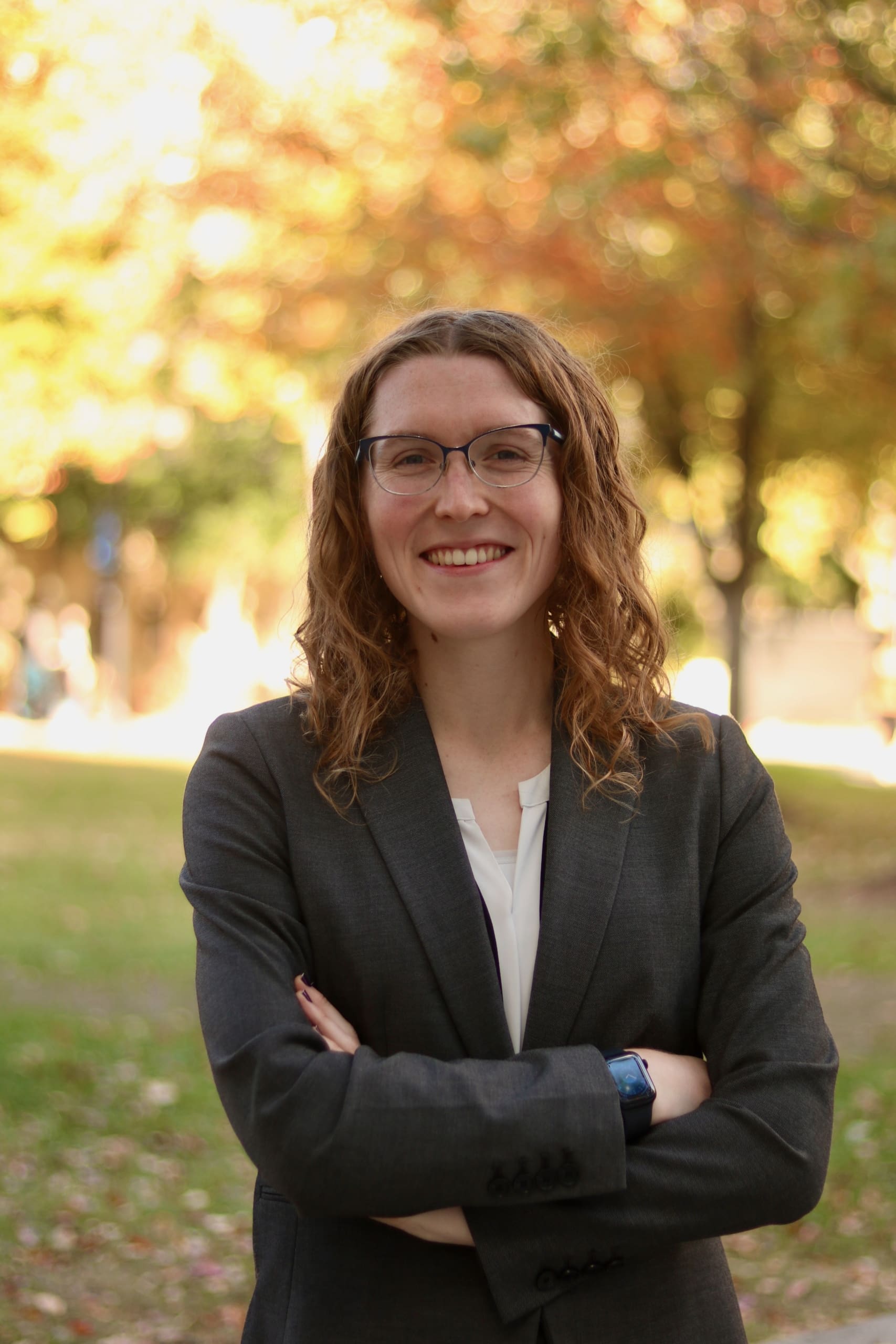
Neighbors play an important role in shaping stronger communities, and Mackenzie is a powerful example of that impact. As a resident of True Ground’s Parc Rosslyn community, a law student, and someone with experience in affordable housing, she brings a unique perspective to the challenges and opportunities facing the housing industry.
Mackenzie recently finished her second year at Georgetown Law, where she has continued to pursue public interest work. This summer, she is interning with Legal Aid DC’s housing unit, building on her commitment to helping renters facing legal challenges maintain stability. Before law school, Mackenzie worked in communications for the Housing Assistance Council (HAC), a national nonprofit that helps build affordable housing in rural communities. HAC runs a loan fund, administers training and technical assistance, and provides research and information services. Mackenzie, who has always been interested in public service, describes the work as “life-changing.” After undergrad, she wanted to find work that connected her to a mission larger than herself.
While taking a seminar on affordable housing law, Mackenzie and her professor discussed potential research paper topics. When she shared that she lives at Parc Rosslyn, a mixed-income Low-Income Housing Tax Credit (LIHTC) community with both affordable and market rate units, her professor noted how unique the model was. The conversation sparked a question Mackenzie wanted to better understand: how do different housing types coexist in the same property, and why has this model not been replicated more widely?
Located in the heart of Arlington County’s Rosslyn neighborhood, Parc Rosslyn is a 15-story mixed-income property with 100 designated affordable units and 138 market rate units . During her research, Mackenzie found that only 14 of Virginia’s 1,475 active LIHTC projects are majority market rate. She highlighted that Parc Rosslyn is 1 in 100. Her research discusses how the LIHTC program works, the challenges developers face, the debate around the goals of mixed-income projects, the history of Parc Rosslyn, and lessons for the housing community when building mixed-income developments using LIHTC.
Mackenzie was thorough in her primary research, including finding footage from the 2004 Arlington County Board meeting where Parc Rosslyn was approved, reviewing County Board packets, and examining other materials. She realized that while she understood the project’s original vision and its current state, she lacked insight into how it functioned in practice. To bridge that gap, she interviewed Carmen Romero, President and CEO of True Ground, whose expertise helped illuminate both the successes and challenges of Parc Rosslyn. Carmen is cited 16 times throughout the paper, underscoring the complexity of developing and operating mixed-income LIHTC communities.
Mackenzie’s research points to a larger reality: the national housing crisis is difficult to solve because building and financing housing is inherently challenging. If the solutions were simple, the problem would have been solved long ago. Programs like LIHTC have created many affordable homes, but they can be complex, expensive, and challenging to navigate, especially for smaller organizations. Mackenzie states that if public policy programs are not designed to work for smaller organizations with limited capacity, or to help those organizations build capacity over time, it will be difficult to scale meaningful solutions. Otherwise, these policies will work only in places that already have the greatest access to resources. At a high level, Mackenzie is examining a complicated problem: how to strengthen the development process so communities can build more affordable housing and make existing tools work better. Her research is thorough, informative, and grounded in both historical context and firsthand insight. Progress in this space depends not only on policy improvements, but also on partnerships among communities, practitioners, and emerging leaders like Mackenzie.
By engaging deeply with her community and contributing to important housing conversations, Mackenzie exemplifies the thoughtful leadership needed to advance the field. Her commitment to public service, research, and community impact serves as an inspiring example of how individuals can drive meaningful change.
Mackenzie loves her home at Parc Rosslyn and the broader Arlington community. She appreciates Arlington’s urban design, including the ability to walk down the street and hear several languages spoken. She also recognizes the leaders who came before her, including Ellen Bozman and Carrie Johnson, for helping shape Arlington into the place it is today. Mackenzie has called Parc Rosslyn home since 2021 and is grateful to have extended her lease again. To her, the building does not feel like an abstract asset to the community; it feels like home.
After law school, Mackenzie wants to continue her public interest work. She is particularly interested in housing, zoning, and land use policy, and can see herself serving in state or local government. What’s most important is a job where she can help people.
Her journey is a reminder that progress depends on people who are willing to learn, connect, and contribute. In Mackenzie’s words, “It is a broken world that we live in, and our only hope is if we can try to repair it together.” Through her work and commitment to community, she is doing her part to build a stronger future where everyone can thrive.